




How can we envision the Mediterranean of tomorrow? What challenges will Mediterranean societies face in response to climate change, geopolitical tensions, pressure on natural resources, and economic and social issues?
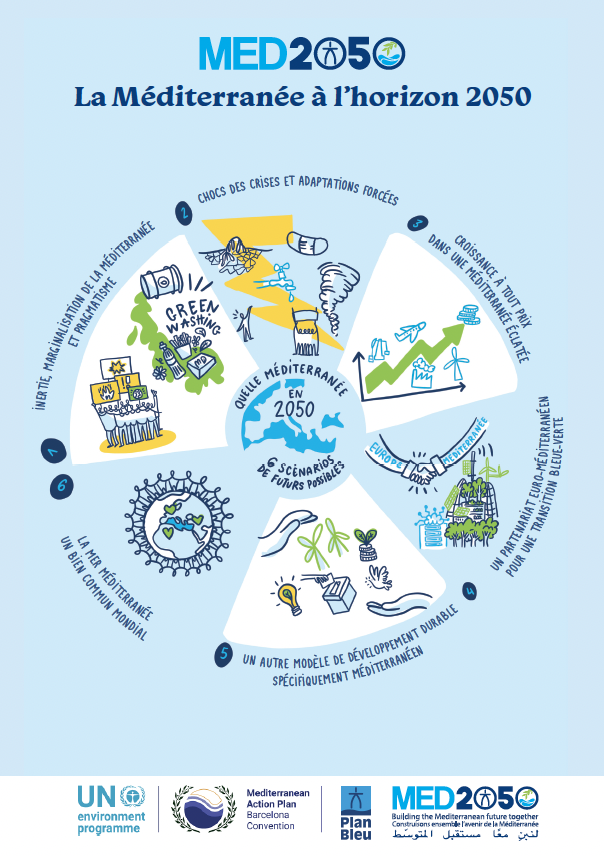
To address these questions and make the initial findings of the foresight exercise “MED 2050: The Mediterranean by 2050” accessible to a wider audience, Plan Bleu has published an illustrated booklet featuring sketchnotes and visual summaries of the MED 2050 scenarios.
This publication offers a visual, educational, and concise presentation of six scenarios exploring possible futures for the Mediterranean region by 2050: inertia, Mediterranean marginalization and pragmatism; successive crisis shocks; growth at all costs; the blue-green transition; a new Mediterranean-specific sustainable development model; and the recognition of the Mediterranean Sea as a global common good. Each scenario examines a potential pathway for the region and highlights the collective choices that could shape its future.
Designed as an awareness-raising and knowledge-sharing tool, the booklet translates complex foresight reflections into accessible sketchnotes and infographics. Each illustration helps readers better understand the interactions between the environment, economy, governance, societies, technologies, and territorial dynamics that define the Mediterranean’s key challenges.
Beyond the foresight exercise itself, this publication invites everyone experts, decision-makers, educators, students, younger generations, and citizens—to engage in a collective reflection on desirable futures for the Mediterranean. As Khadidja Amine, Foresight Officer at Plan Bleu, explains in the foreword, the purpose of the MED 2050 scenarios is not to “predict with certainty what the Mediterranean will look like over the next twenty-five years,” but rather to “open up possibilities” in the face of the challenges the region may encounter and help stakeholders prepare for them.
This outreach initiative is fully aligned with Plan Bleu’s commitment to promoting participatory foresight and raising broad awareness of the major challenges facing the Mediterranean region. Its message serves as a powerful reminder that the Mediterranean is a shared common good and that its future depends on the collective choices made today, at every scale.
The booklet is now available online.