





From 27 to 29 May 2026, Plan Bleu participated in two major events dedicated to the blue economy and sustainable finance in the Mediterranean and beyond: the 17th edition of the Monaco Blue Initiative (BMI) and the second Blue Economy & Finance Forum (BEFF), both held in Monaco.
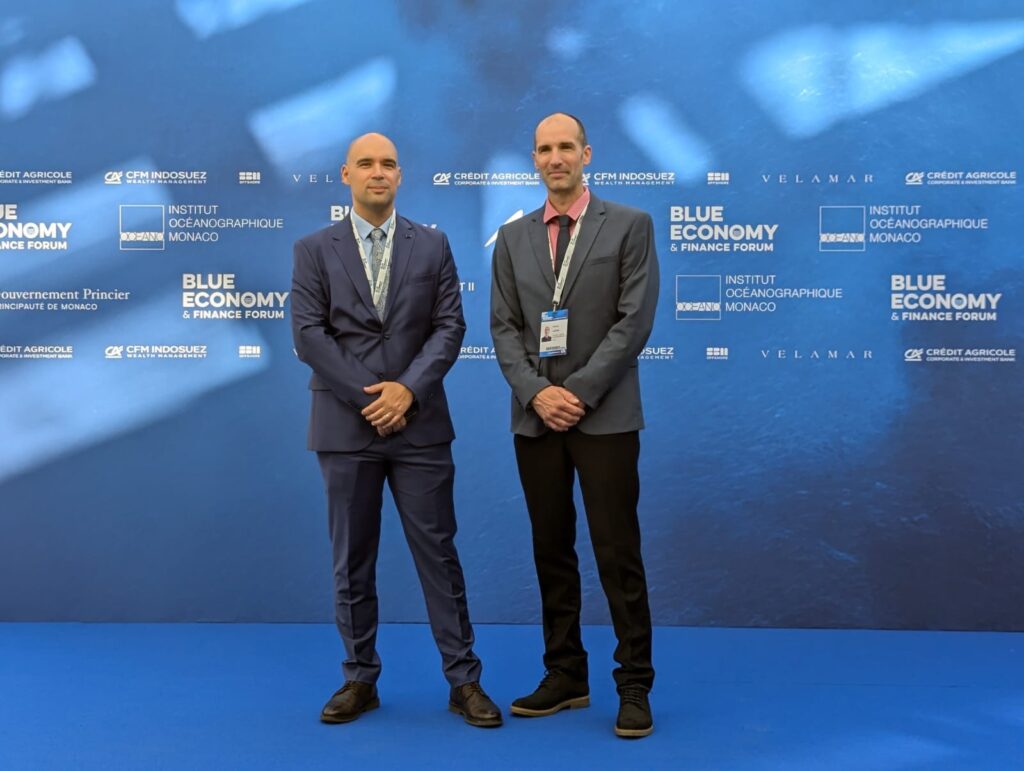
Represented by Antoine Lafitte, Director of Plan Bleu, and Dr. Constantin Tsakas, Chief Economist, Plan Bleu took part in these strategic discussions alongside public institutions, financial stakeholders, investors, international organizations, and non-governmental organizations committed to ocean conservation.
A Growing International Momentum for Blue Finance
The Monaco Blue Initiative, held on 27 May 2026 at the Oceanographic Museum of Monaco, launched a series of high-level discussions on the conditions required to foster a sustainable, inclusive, and science-based blue economy.
Building on these exchanges, the Blue Economy & Finance Forum, held on 28 and 29 May, brought together investors, start-ups, financial institutions, and ocean economy stakeholders around a common objective: accelerating the mobilization of capital and initiatives to support the ecological transition of maritime activities and the protection of marine ecosystems.
The discussions highlighted several key priorities:
- The central role of blended finance in reducing risks and leveraging private investment;
- The development of investable project pipelines within the blue economy;
- The decarbonization of maritime transport;
- The creation of innovative financial instruments dedicated to ocean protection;
- The integration of nature-related risks into financial decision-making.
During his intervention on 27 May, Antoine Lafitte presented an analysis of the main structural challenges facing the Mediterranean in terms of governance and marine ecosystem protection:
- Exceptional biodiversity that is increasingly exposed to pressures from maritime transport, fisheries, pollution, and climate change;
- High seas areas that remain insufficiently protected and often lack a clear legal status;
- Exclusive Economic Zones (EEZs) characterized by overlaps and uncertainties in several parts of the Mediterranean basin;
- Uneven capacities among States to implement the BBNJ Agreement (Biodiversity Beyond National Jurisdiction);
- A complex institutional landscape involving multiple stakeholders (the European Union, UNEP/MAP, GFCM, IMO, national governments, and NGOs), requiring stronger coordination.
In this context, the BBNJ Agreement emerges as a key framework for strengthening high seas governance in the Mediterranean, addressing coordination gaps, and supporting regional objectives, including the Barcelona Convention, the Mediterranean Strategy for Sustainable Development, and international biodiversity targets such as the 30×30 goal.
Plan Bleu’s Role: Bridging Science, Public Policy, and Finance
The discussions held in Monaco confirmed a growing convergence among public authorities, private-sector actors, and civil society around the need to translate ambitions into concrete action.
For Plan Bleu, these dialogues are essential. The institution supports Mediterranean countries in designing science-based public policies that promote sustainable development. It also plays an increasingly important role as a bridge between sustainable finance actors and field-based organizations, helping to strengthen the coherence and impact of ongoing initiatives.
Current work on sustainable finance in the Mediterranean, particularly within the framework of the new Mediterranean Strategy for Sustainable Development (MSSD 2026–2035), aims to better align investment flows with climate objectives, biodiversity conservation goals, and long-term resilience priorities.
At the conclusion of this mission, Plan Bleu welcomes the synergies that were strengthened and the shared commitment among stakeholders to move from ambition to implementation.
These exchanges reinforce the conviction that the transition towards a sustainable blue economy in the Mediterranean requires stronger cooperation between science, public policy, and finance in order to address the region’s environmental and economic challenges.