







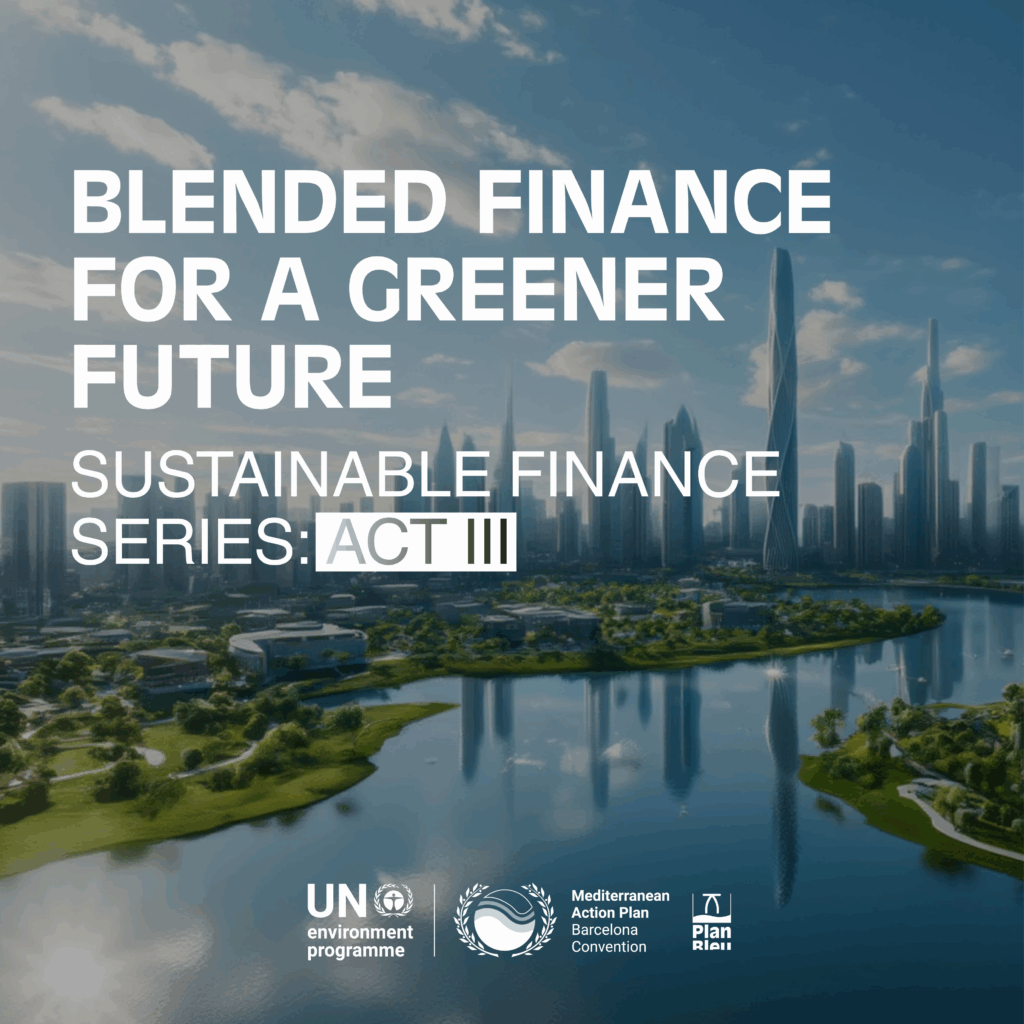
Following a highly competitive review process for its Sustainable Finance Series: Act III, Plan Bleu has officially selected the 8 core chapters that will make up its upcoming volume. Plan Bleu’s edited volume, “Blended Finance for a Greener Future”, part of its Program of Work 2026-2027, will explore how strategically combining public resources with private capital can bridge the Mediterranean’s sustainability investment gap.
The call for papers generated immense regional interest, receiving a total of 28 proposals involving 38 unique authors. The final selection highlights exceptional gender and regional representation: the author pool features 20 women and 18 men, and an impressive 27 of the 38 authors hail from a South or East Mediterranean University.
Below is the finalized Core 8 lineup.
- “Blended Finance for Climate Resilient Development: Assessing Mitigation and Adaptation in the Mediterranean Basin” (by Myriam Ramzy and Nancy Barakat Rodulf)
This paper provides an essential multi-country macro-panel data (2013-2023) necessary to open the volume, specifically tracking the persistent allocation imbalance between climate mitigation and adaptation.
- “Beyond De-Risking: The Insurance Gap in Mediterranean Adaptation Finance A Risk-Regime Analysis” (by Mehmet Murat Çobanoğlu)
It uses spatial correlation to show why local banks cannot diversify adaptation risks, providing an explanation for why standard de-risking instruments fail in climate adaptation.
- “Blended finance readiness for climate adaptation, biodiversity, and ecosystem restoration in the Mediterranean” (by Stella Tsani and Chrysoula Chitou)
It provides a crucial regulatory and institutional baseline for the volume. By constructing a quantitative “Blended Finance Readiness Matrix,” it evaluates 6 Mediterranean countries across legal, fiscal, financial, and ESG pillars to pinpoint exactly why private capital avoids certain markets despite concessional support.
- “Does ESG Performance Drive Firm Competitiveness in the Mediterranean Countries? Evidence and Implications for Blended Finance” (by Ibrahim Alnafrah and Sulaiman Mouselli)
This paper offers empirical evidence against corporate greenwashing, utilizing a massive dataset of publicly listed companies across 13 countries.
- “The Formality Trap: How Blended Finance Excludes the Informal Economy and What Can Be Done About It Evidence from the Southern and Eastern Mediterranean” (by Ceyhun Elgin)
This paper brings a unique focus to the volume, using MIMIC/DYMIMIC econometrics to expose how blended finance structures systematically exclude the informal economy, which constitutes 30-60% of GDP across the Southern and Eastern Mediterranean.
- “Gender and Blended Finance in Tunisia: Microfinance Institutions as Channels for Women’s Inclusion in Green Finance Mechanisms” (by Dorsaf Ben Taleb Sfar)
This paper provides a tangible case study for the development of blended finance tools. It answers the call’s mandate for social inclusion by demonstrating how local Microfinance Institutions can pair green funds with gender equality and women’s empowerment in a Southern Mediterranean context.
- “Filling the Blue Funding Gap: Investigating Blended Finance as a Mechanism for Advancing Marine Biodiversity Performance” (by Widad Metadjer and Zahra Derriche)
Moving the volume into the marine space, this paper uses an Interrupted Time Series (ITS) design to link financial flows directly to actual physical metrics of nature, specifically tracking seagrass restoration performance.
- “Blockchain and Blended Blue Bonds: Strengthening Impact Integrity in Mediterranean Coastal Restoration With Institutional Application to France” (by Soumia Yekhlef and Fethallah Benmokhtar)
This paper introduces a digital governance framework that uses smart contracts and Oracle data feeds to automate marine restoration verification, offering a cutting-edge solution to eliminate blue-washing in coastal investments.
This forthcoming volume, expected by late 2026 or early 2027, is being developed under the scientific coordination of Dr. Constantin Tsakas, Chief Economist at Plan Bleu.
Previous editions of Plan Bleu’s Sustainable Finance series are available below:
Edited Volume ACT I – Unraveling the Impact of Environmentally Harmful Subsidies in the Mediterranean
Edited Volume ACT II – Green Finance: A Strategic Lever for Resilience and Sustainability in the Mediterranean