






1. Background information
The responsible for the contract
This offer is developed by Plan Bleu, in the framework of the Output 1.1 Capitalisation Report of the Interreg Euro-MED thematic project Natour4CChange.
Plan Bleu is established in the form of a French association (law 1901), based in Marseille, France. The Mediterranean Action Plan (MAP) is one of the main components of the Regional Seas Programme of the United Nations Environment Programme (UNEP). It has a legal instrument: the Barcelona Convention and relies on six regional activity centres (“RACs”) responsible in particular for promoting the implementation of seven protocols attached to the convention. Plan Bleu is one of these six RACs mandated by the twenty-one countries, Contracting Parties to the Barcelona Convention and the European Union . Plan Bleu acts as an observatory of the environment and sustainable development in the Mediterranean, and conducts thematic, systemic and prospective analyses to enlighten decision-makers of the region on the environmental risks and the challenges of sustainable development.
Introduction and contextualisation
The Mediterranean region is one of the most vulnerable hotspots in the current biodiversity and climate crises, warming 20% faster than the global average and being the second biodiversity hotspot in the world. The increase of severe climate events are also likely to influence the choice of destinations and time to travel for its over 510 million inhabitants. The effects of climate change will put additional pressure on already strained ecosystems and vulnerable economies and societies, with Tourism being one of the most affected economic sectors.
The recent Transition Pathway for Tourism and the Glasgow Declaration are building a global momentum for Climate Action in Tourism, but policymakers and destinations need support to better develop efficient climate mitigation and adaptation policies using ecosystem-based approaches and improved multi-level governance structures, including robust planning and ensure the long-term engagement of the private sector and citizens. Indeed, ecosystem-based management is considered a good practice to effectively deal with these threats as it considers the different stakeholders and factors affecting ecosystems and the mechanisms involved, in order to find solutions.
About Natour4CChange
NaTour4CChange builds on and capitalises on successful experiences at the Mediterranean and global level to test solutions for increasing the resilience of coastal destinations in the Mediterranean. The project will aim to set common methods to allow participating regions to assess their tourism-related climate adaptation and mitigation priorities, and take climate action via plans and strategies, supported by cooperative governance.
In coastal destinations, cross-sector teams will deliver specific tourism climate Action Plans, focusing on climate adaptation, where Nature-based Solutions (NbS) will be tested to ensure their feasibility. At the same time, innovative destination marketing and communication approaches will engage private stakeholders, visitors, and residents in climate action.
The project will also ensure cross-fertilisation among participating regions and destinations, to achieve common methods and to compare the different tested plans and solutions, leading to lessons, best practices, and policy.
In the framework of NaTour4CChange, Plan Bleu coordinates the WP1 “Methods and Learnings” that aims at creating the methods and sharing progress and learnings, designing the Climate Change action planning for project’s Regions and improving the Climate Change-related resilience of pilot tourism destinations.
Projects’ Achievements
The Natour4CChange project achieved within the WP1 significant results by testing a full set of four complementary methodologies across five pilot regions and seven pilot destinations:
- First, partners developed the Approach to the identification and assessment of the main coastal tourism-related issues, establishing a robust diagnosis of climate risks affecting Mediterranean destinations.
- Building on this, the Approach for drafting Regional and Destination Tourism Climate Strategies and Plans enabled territories to co-design forward-looking tourism adaptation and mitigation strategies with regional and local stakeholders.
- The project then operationalised climate action through the Approach to implement Nature-based Solutions (NbS) at destination level, testing concrete NbS interventions tailored to local vulnerabilities. Business and financial guidelines will be issued as well to support pilot sites.
- Finally, Natour4CChange developed innovative approach in destination marketing and visitor communications for climate action, enhancing the visibility and tourism value of NbS while raising awareness among visitors and operators.
Together, these four methodologies formed a comprehensive, replicable framework linking climate-risk assessment, strategic planning, NbS deployment and marketing innovation. The project demonstrated its applicability across diverse contexts, strengthened multi-level governance and reinforced capacities for climate-resilient tourism development.
2. Description of the Work
Purpose of the call and expected results
The objective of this assignment is to produce the full written content of the NT4CC Capitalisation Report, which will synthesise and promote the overall project’s achievements, methodologies, lessons learned, and policy messages. Building on the project’s Methodologies and on contributions from all partners, Regions, Pilot Destinations and Associates, the consultant will develop a comprehensive and user-friendly output to be presented at the final public event.
This assignment covers exclusively the content development of the capitalisation document. A separate tender will be launched for the graphic design and layout of the report. Therefore, the consultant is expected to draft the content with a clear vision of how it could be visually presented (e.g., key messages, infographics, diagrams, boxes, case summaries), while not being responsible for the final design work.
This output should serve both as a knowledge legacy and a toolkit of replicable tools for future adaptation initiatives in coastal tourism. It will include:
TASK 1 : A didactic summary of the four core NT4CC methodologies:
Presented in a clear but synthetic way, to be used as source for a visual format (e.g. infographics, process diagrams, step-by-step guidance) to be developed by another service provider, this section should describe and simplify the following project approaches:
- Methodology for identifying and assessing key coastal tourism challenges
- Approach for developing Regional and Destination Tourism Climate Strategies and Plans
- Approach for testing and implementing Nature-based Solutions (NbS) at Destination level and financial and business models for funding these solutions in the long term
- Approach for destination marketing and visitor communication for climate action
This section should provide practical guidelines on:
- How to plan climate-resilient coastal tourism using NbS?
- Which governance bodies to involve (Regional Coordination Units – RCU) at regional level and Tourism Climate Action Taskforce at destination level, both developed under the framework of the project NT4CC?
- How to mobilise funding for NbS and adaptation actions?
- How to engage tourists and tourism operators through communication and marketing strategies?
TASK 2 : Case Studies showcasing best practices from pilot sites and regions
The consultant will create a format to be used to describe the 12 case studies (covering the 5 pilot Regions and the 7 pilot destinations), highlighting the diversity of solutions and innovations developed within NT4CC. Each case study should be presented as a stand-alone factsheet, including:
- Main descriptive information of the pilot site
- Description of the process and implementation steps
- Key results and impacts, challenges and keys lessons according to the evaluation criteria developed in the Task 4.
- Contributing partners and stakeholders
- Specific section on replicability factors (conditions, enablers, constraints, transfer potential)
The consultant will also prepare the necessary material for the integration of:
- At least 2 Destination-level practices into the PANORAMA Solutions platform (IUCN)
- At least 1 Regional practice into the Interreg MED Policy Learning Platform, in coordination with HSPN
TASK 3 : Policy recommendations
The consultant will develop concise, visually appealing policy briefs that can be extracted and used independently, for example as posters or flyers during policy events.
These « one page policy recommendations » would summarise the key recommendations developed by Natour4CChange on various topics (e.g 1 page on governance, 1 page for NbS integration, one for fundings…) or be tailored to specific target groups: decision-makers (EU, national, regional, destinations), private stakeholders (hotels, TOs), communities and civil society, programmes and donors, ect. Those policy briefs will be presented during the project’s final conference.
The capitalisation report will support policy uptake and replication by translating project results into actionable and transferable recommendations aligned with Mediterranean sustainability and climate adaptation objectives. Outputs will be designed for long-term use beyond the project, including reusable toolkits and policy briefs.
This component will be developed with the support of the CPMR-IMC, ensuring that the policy recommendations are grounded in the identified practical needs of its members
TASK 4 : project’s results assessment
In addition, the consultant will propose a simple evaluation methodology to be exploited by the project partnership for assessing the project’s results. This task includes proposing clear criterias, indicators and a simple assessment framework that Project Partners can use to evaluate the effectiveness, added value and replicability of the NT4CC approach through a comparative analysis of actual results of the implementation of the four above quoted methodologies in the 12 case studies.
Expected schedule and tasks
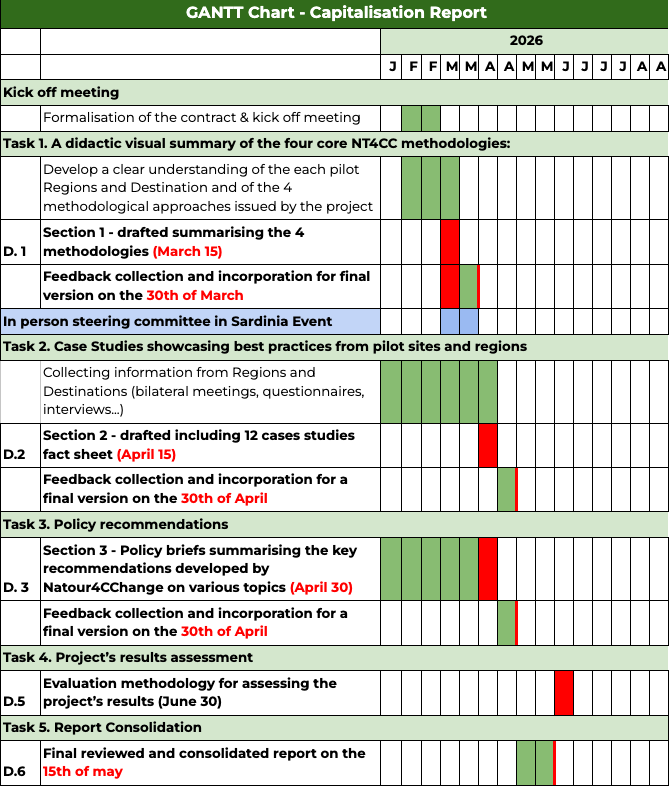
The assignment with the contractor will start in February 2026 and will conclude at the end of May 2026.
A tentative schedule, which can be refined in the applicants’ offers is the following:
3. Profile of the tender
PLAN BLEU is seeking a seasoned consultant with strong interpersonal skills and previous experiences in conducting work on sustainable tourism and climate change adaptation issues in coastal destinations, integrating Nature Based Solutions. The following criteria will be assessed:
Experience:
- Relevant experience (> 10 years) in the field of Climate Change adaptation issues, with good knowledge on sustainable tourism policies for coastal Mediterranean destinations and Nature Based Solutions; ;
- A good knowledge of Mediterranean sustainable tourism stakeholders and especially on EU programmes and Interreg funding mechanisms;
- Experience in designing institutional documents and best practices reports, capitalization reports or knowledge management
- Recognised expertise and strong reputation in the international tourism sector, enabling broad visibility of the thematic paper and effective dissemination beyond the Interreg Euro-MED community.
Competences:
- Strong experience in data collection management, harmonization and analysis related to a given project framework;
- Excellent analytical, synthesis and writing skills in English;
- Ability to mobilise stakeholders, follow the methodology provided and exploit the existing knowledge in an efficient way;
- Knowledge of the Mediterranean Basin and stakeholders related to sustainable tourism and marine protected areas with a focus on climate change adaptation issues.
The selection of the expert will be done based on a presentation of a technical offer, an economic offer, as well as a letter of interest and a resume making reference to these Terms of Reference.
4. Application procedure
The offer, containing :
- The methodological approach/plan of work that will be followed for the development of the contract,
- a description of the organisation’s experience and/or the concise curriculum vitae of the candidate(s),
- an economic offer
- For French consultants:
- a document certifying their registration with the Trade and Companies Register (Registre du Commerce et des Sociétés), or their identification card proving their registration in the trades register (répertoire des métiers), or a certificate of registration with URSSAF.
- A certificate of compliance (“attestation de vigilance”) from the Social Security scheme for self-employed workers (if they are not affiliated with the general Social Security scheme).
- For foreign consultants:
- a sworn statement confirming that they are up to date with their tax and social security contributions in their country (and ideally, where possible depending on the country, a document issued by the relevant authorities confirming that their contributions are up to date).
must be sent in one file in PDF format to : [email protected] and before 23:59 CET on 15th of February 2026.
Applications can be also submitted through Plan Bleu website: www.planbleu.org.
Review of Proposal and Awards Criteria
Plan Bleu, as a contracting body, will proceed to examine the documentation provided to verify compliance with the technical and economic requirements of the bids and may request from the tenderer any additional documentation required. The contracting authority shall exclude from the valuation and proposal of award the bids that do not comply with the requirements of the contract. Following the examination of the proposals, and after a detailed assessment of the selected offer, a team – whose composition shall be determined internally – will formulate the corresponding final proposal of the award. In the event of observing omissions or deficiencies in the documentation provided, the applicable legislation for the correction of defects and omissions in documentation will apply.
The presentation of the certifications accrediting the fulfillment of the tax and social security obligations by the tenderer will be mandatory.
Selection Process
The selection of the consultant will be realised jointly by Plan Bleu and technical partners based on the evaluation of the technical and financial offer.
Evaluation of methodological approach, maximum 30 points.
Evaluation of the experience of the organisation and/or concise resume of the candidate. Knowledge of the issues and prerequisites on Climate Change Adaptation and tourism policies for the tourism sector. 40 points.
Evaluation of the economic offer, maximum 30 points.
The offer that gathers the maximum score will be selected.
5. Contractual and Financial Terms
Administrative details of the Contracting Authority
This consultancy will run from the date of the contract signature by both parties to the 30th of June 2026.
Potential travel and accommodation costs related to this mission will be covered separately by Plan Bleu and should not be included in the contract amount. Funding for these activities is secured through both EU-Interreg funding and co-financing from Plan Bleu.
The acceptance of the selected offer implies acceptance of the terms and detailed schedules outlined in these Terms of Reference, including the following payment schedule (negotiable) :
- 30% of the contract amount will be paid upon signature of the contract
- 70% of the contract amount will be paid upon validation of the final deliverable
A properly issued invoice will be required for the scheduled payments, containing the following mandatory details:
- Full name + address of the service provider
- SIRET number (France) or tax number (for non-France)
- Invoice issuance date
- Invoice number
- Service description (e.g., name of the deliverable)
- Amount excluding taxes (HT), VAT, and total amount (TTC), in the currency specified in the contract
- For individuals not subject to VAT (France): include the mention “TVA non applicable, article 293B du code général des impôts”
The payment term for invoices will be as follows: bank transfer within 15 days after the invoice date.
The tax legislation in force at the date of acceptance of the offer will be applied.
Budget
The maximum amount available for this service is € 11 000 including VAT (total taxes included) to be paid at the end of the contract.
Contracting and Payment
The acceptance of the offer of the successful tender implies the acceptance of the conditions and schedules detailed in these ToRs. The payment term for the invoice will be made by bank transfer (bank account details will be asked).
Formalisation of the Contract
The contract must be formalised in writing by 31 January 2026. The contract shall enter into force by its signature and will last until 30 June 2026.
Conditions Governing the Use of AI within the Assignment
Clause 1 – Controlled use of artificial intelligence : The service provider is authorised to use generative artificial intelligence (AI) tools, provided that their use is strictly limited to support functions: assistance with structuring, brainstorming, document exploration, or editorial optimisation. The use of AI may under no circumstances replace the analytical work, source verification, or expert writing expected within the scope of the assignment. Artificial intelligence must under no circumstances replace human expertise or rigorous scientific methods. In particular, it may not be used to produce numerical estimates or to generate modeling results (economic, econometric, mathematical, or other), which must be based on validated, documented approaches implemented by the service provider. Any reference to a study, article, numerical data, or academic source must be rigorously traceable and verifiable through precise references (title, author, publication, date, or link).
Clause 2 – Responsibility for content and transparency : The service provider remains fully responsible for the quality, accuracy, reliability, and consistency of the deliverable, including in the case of partial use of artificial intelligence tools. All information, data, or quotations appearing in the final deliverable must have been verified by the Consultant, regardless of the method of production. In the event of a clear breach (fictitious sources, fabricated quotations, inconsistent data), Plan Bleu reserves the right to request a revision at no additional cost, or even to terminate the contract and cancel all or part of the payment in the event of failure to meet deadlines. The Consultant is obligated to explicitly declare any use of AI tools in the preparation of deliverables. The Consultant must transparently indicate the parts of the work that were carried out with the assistance of an AI tool and may be asked to provide the methodology or queries (prompts) used.
Clause 3 – Quality responsibility : The Consultant remains solely responsible for the accuracy, originality, verification, and professional quality of deliverables, including those produced or assisted by AI. The use of AI tools cannot, under any circumstances, justify factual errors, plagiarism, bias, or breaches of confidentiality.
Clause 4 – Non-compliance and consequences: In the event of non-compliance with this clause, the client may request the Consultant to:
- revise the deliverables at no additional costs
- or, in the event of serious or repeated breach, to apply the contractual provisions relating to non-conformity or termination.