




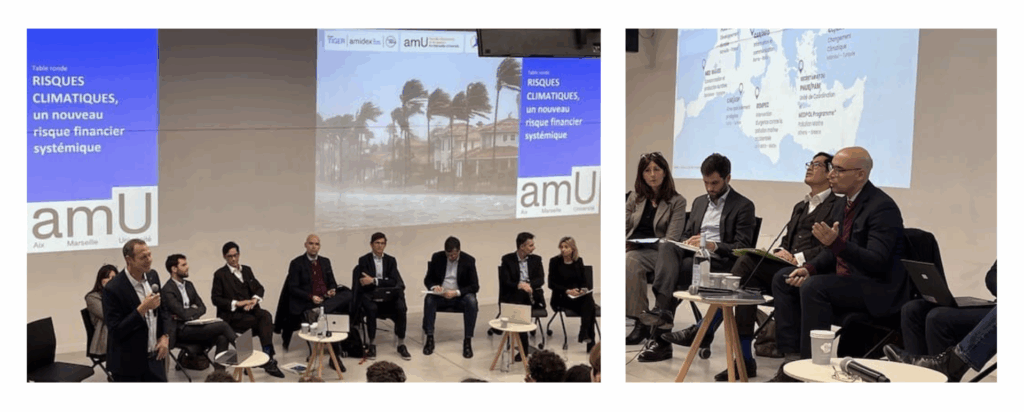
On January 28, 2026, the Chief Economist of the Blue Plan, Dr. Constantin Tsakas, participated in a high-level roundtable organized by the Aix-Marseille School of Economics (AMSE) on the theme “Climate Risks: A New Systemic Financial Risk.” The event brought together leading experts from the French Prudential Supervision and Resolution Authority (ACPR), the Financial Markets Authority (AMF), the European Environment Agency, as well as representatives from the private sector and academia.
Green Economic Tools to Transform the Mediterranean Basin
During his intervention, Dr. Tsakas presented the findings from the two volumes published by the Blue Plan on sustainable finance in the Mediterranean. The first volume highlighted the scale of the current paradox: countries spend five to six times more public funds on environmentally harmful subsidies (fossil fuels, overfishing) than on protecting the environment. In response to this alarming situation, the second volume offers a practical toolbox to reverse this trend.
The Blue Plan’s work demonstrates that the effectiveness of green economic instruments varies depending on the context. Environmental taxation, for example, only becomes effective when combined with strict regulatory enforcement. In Southern Mediterranean countries, energy taxation has proven to be a powerful driver of innovation in energy efficiency, particularly for energy-intensive companies.
Three Imperatives for Mediterranean Policymakers
Dr. Tsakas highlighted three key messages for regional policymakers:
-
Stop funding degradation. Before seeking new sources of finance, it is crucial to redirect existing flows by gradually phasing out subsidies for fossil fuels and overfishing, while protecting vulnerable populations.
-
Adopt tailored regulation. There is no one-size-fits-all solution for the Mediterranean. The effectiveness of any policy tool depends on the local context. Carbon taxes, for example, must be calibrated to the social cost of carbon in each country and paired with appropriate redistribution mechanisms.
-
Leverage public funds to unlock private capital with integrity. Public funds alone cannot fill the investment gap. Governments must act as catalysts through blended finance to attract private capital. However, to avoid greenwashing, establishing a Mediterranean Taxonomy of Sustainable Activities is a major priority.
A Mediterranean Framework for Classifying Sustainable Activities: A Priority for 2027
Dr. Tsakas emphasized the urgent need to develop a Mediterranean framework for classifying sustainable economic activities. This tool will define what is truly “sustainable” in the region and provide clear guidance to private investors. Such a framework is the missing cornerstone for mobilizing the private sector at scale.
As part of the new Mediterranean Strategy for Sustainable Development (SMDD), the Blue Plan will play a central role in facilitating and coordinating green finance networks. In 2026, efforts will focus on blended finance and the role of the private sector, while 2027 will be dedicated to developing this Mediterranean green classification system.
A Crucial Dialogue Between Science, Policy, and Finance
The roundtable highlighted the systemic challenges that climate risks pose to financial stability, while also showcasing concrete solutions. The Blue Plan’s presence alongside European financial regulators and major economic actors underscores the vital role of environmental expertise in building a resilient and sustainable financial system for the Mediterranean.
For more information:
Blue Plan – Regional Activity Centre of the United Nations Environment Programme / Mediterranean Action Plan
Contact: [email protected]