



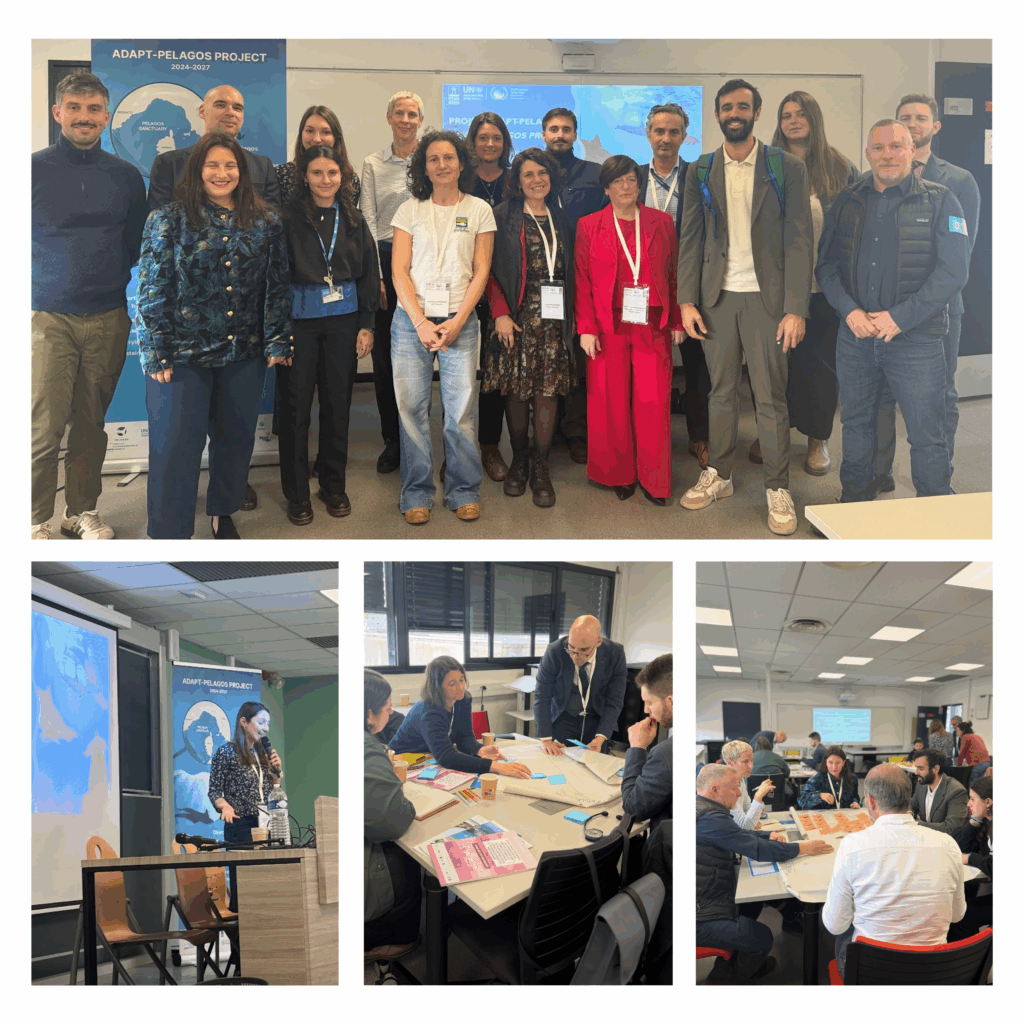
On March 18, 2026, Plan Bleu co-organized with the Lab’Homère of the University of Toulon the second workshop of the Adapt Pelagos project, focused on a key issue for the Mediterranean: sustainable tourism, climate change adaptation, and integrated coastal zone management (ICZM). Hosted at the Faculty of Law in Toulon, this workshop brought together experts, public institutions, marine protected area managers, tourism stakeholders, and researchers for a day of exchanges and co-creation around the sustainability of the blue economy in the Pelagos Sanctuary.
This workshop is part of the Adapt Pelagos project (2024–2027), which aims to promote and share best practices to support the adaptation of blue economy activities to the effects of climate change.
The Pelagos Sanctuary, a unique cross-border cooperation area between France, Monaco, and Italy, is one of the richest marine ecosystems in the Mediterranean. It is home to numerous marine mammal species.
However, this territory faces a double pressure:
-
the intensification of tourism activities, a major economic driver in the Mediterranean
-
the impacts of climate change, which increase ecosystem vulnerabilities
Workshop Highlights
The morning was dedicated to introductory keynotes and two roundtables bringing together key actors of the Mediterranean region.
Discussions highlighted:
-
current and future impacts of climate change on coastal tourism in the Pelagos Sanctuary
-
adaptation strategies implemented at different scales, notably by the Sardinia Region and the Nice Côte d’Azur Metropolis / Cap Ferrat MPA
-
existing governance tools to support territories in their transition
-
the structuring role of integrated coastal zone management (ICZM) in balancing economic activities and ecosystem preservation
These exchanges also emphasized the importance of stronger coordination among public actors, marine protected area managers, and tourism professionals.
The afternoon was dedicated to two participatory workshops aimed at turning discussions into operational actions.
Participants worked in groups to:
-
identify or propose action pathways for adapting the tourism sector (economic constraints, governance, social acceptability, monitoring tools)
-
share existing best practices
-
co-create and prioritize actions according to feasibility and urgency
This collaborative approach enabled the emergence of concrete and locally adapted action pathways.
The shared goal is to develop a coastal tourism model capable of adapting to climate change while actively contributing to the protection of marine ecosystems and mammals in the Pelagos Sanctuary.
The contributions and results from this workshop will be summarized in a report with recommendations, which will soon be shared. These outputs will feed into the next stages of the Adapt Pelagos project and support local actors in implementing concrete strategies for sustainable tourism in the Mediterranean.