




ABOUT PLAN BLEU
This consultation is published by Plan Bleu, a French association established under Law 1901 founded in 1977, and a Regional Activity Center of the Mediterranean Action Plan (MAP), based in Marseille, France. The MAP is one of the main components of the Regional Seas Programme of the United Nations Environment Programme (UNEP). It has a legal instrument: the Barcelona Convention and relies on seven regional activity centres (RACs) responsible in particular for promoting the implementation of the seven protocols attached to the convention. Plan Bleu is one of the seven centres mandated by the twenty-two Contracting Parties to the Barcelona Convention including the European Union. Plan Bleu acts as an observatory of the environment and sustainable development in the Mediterranean, and conducts thematic, systemic and prospective analyses to support decision-makers of the region on the environmental risks and the challenges of sustainable development.
About water topics – background and context:
The Mediterranean basin is one of the global water stress hotspots and faces mounting pressure from climate change and growing demand. Surrounded by 21 countries with over 500 million people, this climate change hotspot faces unprecedented water challenges that demand immediate and coordinated actions. Since the pre-industrial period (1850), atmospheric surface temperatures have risen by 1.45°C on average, while renewable water resources are projected to decrease by 15-35% by century’s end (2080-2099). The unbalanced reality is significant: northern Mediterranean countries possess 67-74% of regional water resources, while southern nations like Egypt struggle with as little as 589 m³ per capita annually, well below the water scarcity threshold (1000 m³/an/capita). Within the current Mediterranean context, the water paradox is increasingly exacerbated (a depleted and degraded natural resource facing exponential water demand), every drop counts. In this increasingly arid landscape, water holds a special place at Plan Bleu and is at the heart of its activities.
Right after its creation, Plan Bleu was mandated to provide a Mediterranean foresight exercise on water resource evolution. Plan Bleu’s vision on water issues aims to be holistic and aligned with the Barcelona Convention, the Mediterranean Strategy for Sustainable Development, and the Sustainable Development Goals. Water functions as a cornerstone linking economic, environmental, social, and governance issues. Thus, through these different thematic pillars, Plan Bleu advances on these central questions in a Mediterranean basin increasingly impacted by extreme climate events marked by strong seasonality (torrential rains, floods, repeated drought periods, etc.). To this end, Plan Bleu provides various studies covering: sectoral aspects, water risk analyses, prospective studies on water resources, digital tools to monitor the quantitative and qualitative state of the resource through its observatory, as well as socio-economic analyses. In 2025, Plan Bleu has focused on non-conventional water resources, particularly desalination, an adaptation solution addressing water shortages but still controversial, notably regarding its socio-economic and environmental impacts. A scoping study on the Mediterranean water cycle has been realized. This umbrella study provides a systemic vision of the Mediterranean water challenges and potential adaptation solutions to advance on. With this desk study work, Plan Bleu settled its ambitions for advancing and promoting sustainable water management for the upcoming years.
Rationale
Mediterranean countries have demonstrated their commitment to water sustainability through various regional initiatives such as the Mediterranean Strategy for Sustainable Development 2016-2025, and national SDG implementation plans. However there is still a place for improvement notably to reach a regional progress toward SDG6 achievements. Indeed, there are still disparities between the northern and southern shores, also between rural and urban areas. Therefore, Plan Bleu aims at providing an holistic and in-depth analysis of how SDG6 is concretely implemented in the basin. In view of the 6th Mediterranean Water Forum, to be held in Rome from 29 September to 2 October 2026, Plan Bleu is exploring and analyzing this topic.
Why is this SDG6 analysis needed in the Mediterranean basin ?
- To provide a comprehensive baseline assessment of current status across all SDG6 targets and indicators with a cross country analysis
- To identify regional trends, best practices and persistent gaps with potential enablers
- To understand interlinkages between SDG6 and other SDGs within the Mediterranean context
- Support evidence-based policy recommendations and regional cooperation mechanisms
Tasks description
The expert team in charge of this consultation will deliver a technical and comprehensive report on the current state of SDG6 in the Mediterranean basin, examining progress, challenges and opportunities for achieving sustainable water and sanitation by 2030.
6 specific objectives are expected to be reached within this consultation period:
- In-depth analysis of the current status of all SDG6 targets (from 6.1 to 6.6 targets and 6.a, 6.b targets) across Mediterranean countries and potential interdependencies between these ones
- Analyze regional disparities and country-specific contexts
- Identify enabling factors, good practices and barriers for each SDG6 targets achievement
- Examine interlinkages between SDG6 and other relevant SDGs
- Formulate actionable recommendations for accelerating progress
- Contribution to strengthen Plan Bleu’s observatory on water sector especially in identifying data and information at both regional and local level
The analysis will cover all 21 Mediterranean countries: Albania, Algeria, Bosnia and Herzegovina, Croatia, Cyprus, Egypt, France, Greece, Israel, Italy, Lebanon, Libya, Malta, Monaco, Montenegro, Morocco, Slovenia, Spain, Syria, Tunisia, and Türkiye If useful, country clusters (such as sub-regional clusters could be developed).
Applicants may propose alternative or innovative approaches to their methodology and to the consultation process (e.g. survey/questionnaire, tables, other tools) to collect expert inputs, should they consider this to add value. A list of initial organizations to engage with would be appreciated which will be refined with Plan Bleu’s contacts.
The consultant could will undertake the following tasks
Task 1: Comprehensive data collection and analysis through certified and updated database
- Relevant dataset identification and extractions official SDG6 monitoring data from national and international offices (e.g. UN agencies with the SDG6 data portal) complemented with other SDG6 platforms and assessment tools already developed such as the Water4allSDGs.
- Compilation, standardization and in-depth analysis of extracted data on all eight SDG6 targets for all Mediterranean countries.
- Create dashboards of achievement for SDG6 and its targets at Mediterranean and national level (e.g. Dashboard of the Global Status of SDG6). This dashboard could be then integrated in the Plan Bleu regional Observatory.
Task 2: Examination of SDG6 interlinkages and top-down relationship with regional and national frameworks
- Identify and analyze potential direct and indirect dependencies assessment between SDG6 targets
- Identify and analyze potential interlinkages between SDG6 and other SDGs, particularly:
- SDG1 (Poverty) – equal economic resources to access safe drinking water and sanitation
- SDG2 (Zero Hunger) – water for agriculture and food security
- SDG3 (Good Health) – WASH and public health
- SDG7 (Affordable and Clean Energy) – water-energy nexus
- SDG11 (Cities) – reducing climate vulnerability including water related disasters
- SDG 12 (Responsible Consumption and Production) – Reduce waste production and enhance the monitoring of water consumption impacts.
- SDG13 (Climate Action) – climate adaptation and mitigation
- SDG14 (Life Below Water) – marine pollution and coastal water management
- SDG15 (Life on Land) – freshwater ecosystems and biodiversity
- Identify and analyze potential influences between SDG6 targets and regional priorities/objectives of the Mediterranean Strategy for Sustainable Development (MSSD) 2026-2035.
Task 3: Assessment of progress and trends based on the two previous tasks
- Identify regional, sub-regional, and national trends for SDG6 and its targets.
- Analyze trajectories and assess the feasibility for a given country to reach its SDG6 targets by 2030. Different scenarios could be evaluated from business-as-usual to best case scenarios.
- Examine disparities based on geographic location, urban/rural divide, and socio-economic factors.
Task 4: Analysis of enabling factors
- Review policy, legal, and regulatory frameworks for water and sanitation management that may increase the likelihood of achieving the SDG6 targets.
- Evaluate financing mechanisms and investment levels for water and sanitation infrastructure.
- Assess governance mechanisms, including transboundary cooperation arrangements.
- In-depth analysis of target 6.a and target 6.b and its (potential) contribution to overall SDG6 achievement.
Task 5: Case studies and good practices
- Highlight some good case studies if they demonstrate enough transferable potential with replicable solutions
Task 6: Mediterranean roadmap for achieving SDG6 targets
- Propose key actions, milestones and priorities based on the conducted SDG6 analysis in a form of a Mediterranean roadmap for SDG6.
- Political recommendation including: multi-level recommendations from water practitioners to national public authorities. Such recommendations should be realistic, concrete and actionable.
- Provide an outlook for Post-2030 actions related to SDG6.
Timeline and deliverables
The timeline with the expected deliverables is detailed below with a start of the working activities plan for early April 2026 with an approximate total workload of 40 working days spread over 5 months.
- Detailed workplan report: Detailed methodology, work plan, and analytical framework – due 3 weeks after contract signature. The detailed workplan report will refine and operationalize the methodology proposed in the technical offer, incorporating feedback from the kick-off meeting with Plan Bleu and presenting the detailed analytical framework and concrete work plan for validation.
- Draft analytical report (40-60 pages): Comprehensive analysis of all tasks – due 12 weeks after contract signature.
- Final analytical report (40-60 pages): Incorporating feedback from Plan Bleu and stakeholders – due 6 weeks after receiving consolidated comments.
- Executive summary: In English – submitted with final report.
- PPT presentation: For dissemination workshop – submitted with final report.
Data compilation: All datasets, references, and supporting materials in organized digital format.
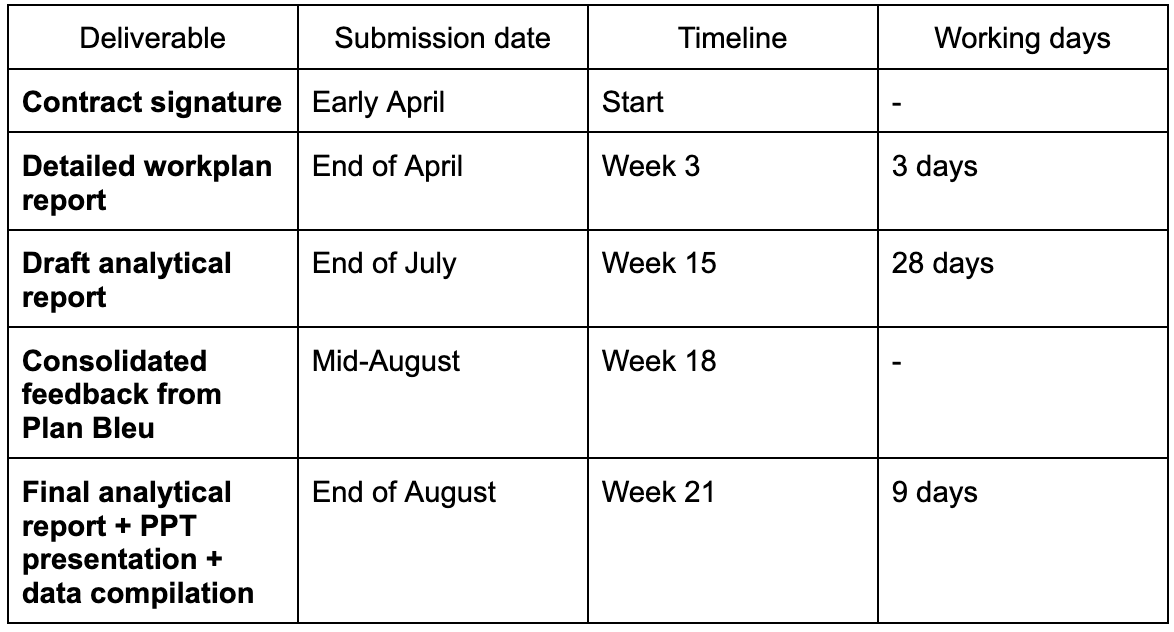
All deliverables mentioned in the table above have to be sent to Plan Bleu in English. The deliverables have to be formally approved by Plan Bleu. No payments will be made without prior approval of the linked deliverables.
Work assessment
The Consultant will be supervised by Mr. Samson Bellières (Water Project Manager and GIS expert) and Ms. Insa Behrens (Project Manager on Water and Climate Change Adaptation).
Budget
The available budget for this consultancy is maximum 17 500 euros VAT included and proposals should not exceed this amount.
Selection of the consultant
Plan Bleu is seeking an experienced team of experts with at least one from the northern Mediterranean shore and one from the southern shore, with technical and scientific expertise on water related topics and a significant background in data analysis. The expert team is expected to have a good knowledge of the state of Mediterranean water resources, its challenges,related initiatives and institutional frameworks.
The Call is open to all experts and researchers working on relevant topics in Mediterranean countries that are Contracting Parties to the Mediterranean Action Plan of the United Nations Environment Programme (UNEP/MAP). This includes: Albania, Algeria, Bosnia and Herzegovina, Croatia, Cyprus, Egypt, France, Greece, Israel, Italy, Lebanon, Libya, Malta, Monaco, Montenegro, Morocco, Slovenia, Spain, Syrian Arab Republic, Tunisia, Türkiye. We particularly welcome contributions from water and environmental scientists, policy and data analysts, and practitioners with experience in water utilities. If pre-selected, candidates must demonstrate their legal capacity to sign contracts and issue invoices according to the legislation of their country. Researchers from the Southern and Eastern Mediterranean, including women and PhD graduates, are encouraged to participate.
Selected candidates will demonstrate the following competences and criteria:
- Education background: University diploma of at least Master’s level or equivalent in water resources management and/or data analysis and/or socio-economic sciences. PhD level will be appreciated.
- Experience: Minimum of 5 years of relevant experience in the water sector and/or the field of sustainable development, with strong knowledge of Mediterranean water related issues and policy aspects.
- Minimum of 5 years of working experience in and specific knowledge of environmental issues in the Mediterranean as well as of the Barcelona Convention UNEP/MAP system, and other governance processes in the region.
- A proven experience in working in multistakeholder cooperation projects and environment and development issues.
- Solid experience in water related projects. Proven experience in the field of sustainable development goals is an asset.
Contractual and financial terms
All deliverables must be formally approved by Plan Bleu before proceeding to the next phase. Payment is conditional upon approval of corresponding deliverables. In case of non-compliance, the consultant has 5 working days to submit a revised version at no additional cost.
The acceptance of the selected offer implies acceptance of the terms and detailed schedules outlined in these Terms of Reference, including the following payment schedule (negotiable) :
- 15% amount of the contract as a down payment will be paid upon the contract signature
- 40% will be paid as an intermediate payment upon delivery of the first analytical draft following the consultation process
- The balance payment will be paid upon validation of the final draft submission and the final presentation.
A properly issued invoice will be required for the scheduled payments, containing the following mandatory details:
- Full name + address of the service provider
- SIRET number (France) or tax number (for non-France)
- Invoice issuance date
- Invoice number
- Service description (e.g., name of the deliverable)
For foreign consultants: a sworn statement indicating that they are up to date with their tax and social security contributions in their country (and ideally, where possible depending on the country, a document from the organisations to which they contribute proving that they are up to date).
For experts/consultants based in France:
a document certifying their registration with the Registre du Commerce et des Sociétés (Commercial and Companies Register), or their professional ID card proving registration with the Répertoire des Métiers (Trades Register), or their certificate of registration with URSSAF.
In addition, a certificate of compliance (“attestation de vigilance”) from the Social Security for the Self-Employed (Sécurité sociale des indépendants), if they are not affiliated with the general Social Security scheme.
For experts based outside France, they will be required to provide a sworn statement certifying that they are up to date with their tax and social security obligations in their country of residence.
Use of Artificial Intelligence
Clause 1 – Controlled use of artificial intelligence
The service provider is authorized to use generative artificial intelligence (AI) tools, provided that their use is strictly limited to support functions: assistance with structuring, brainstorming, document exploration, or editorial optimization. The use of AI may under no circumstances replace the analytical work, source verification, or expert writing expected within the scope of the assignment. Artificial intelligence must under no circumstances replace human expertise or rigorous scientific methods. In particular, it may not be used to produce numerical estimates or to generate modeling results (economic, econometric, mathematical, or other), which must be based on validated, documented approaches implemented by the service provider. Any reference to a study, article, numerical data, or academic source must be rigorously traceable and verifiable through precise references (title, author, publication, date, or link).
Clause 2 – Responsibility for content and transparency
The service provider remains fully responsible for the quality, accuracy, reliability, and consistency of the deliverable, including in the case of partial use of artificial intelligence tools. All information, data, or quotations appearing in the final deliverable must have been verified by the Consultant, regardless of the method of production. In the event of a clear breach (fictitious sources, fabricated quotations, inconsistent data), Plan Bleu reserves the right to request a revision at no additional cost, or even to terminate the contract and cancel all or part of the payment in the event of failure to meet deadlines. The Consultant is obligated to explicitly declare any use of AI tools in the preparation of deliverables. The Consultant must transparently indicate the parts of the work that were carried out with the assistance of an AI tool and may be asked to provide the methodology or queries (prompts) used.
Clause 3 – Quality responsibility
The Consultant remains solely responsible for the accuracy, originality, verification, and professional quality of deliverables, including those produced or assisted by AI. The use of AI tools cannot, under any circumstances, justify factual errors, plagiarism, bias, or breaches of confidentiality.
Clause 4 – Non-compliance and consequences
In the event of non-compliance with this clause, the client may request the Consultant to:
- revise the deliverables at no additional costs
- or, in the event of serious or repeated breach, to apply the contractual provisions relating to non-conformity or termination.
How to apply
Interested candidates are invited to submit the following documents :
- A technical offer including a summary of a scientific article, comprising a brief description of the methodology and a curriculum vitae highlighting relevant experience in water and sustainable development related fields.
- A financial offer with an estimation of working days.
The application files must be submitted no later than 6 April 2026 to Samson Bellières, Water Projects Manager at Plan Bleu, [email protected] and Insa Behrens, Project Manager in Water Management and Climate Change Adaptation, [email protected], with the subject line: Plan Bleu Consultancy – SDG6