



About Plan Bleu:
This consultation is published by Plan Bleu, French association founded in 1977, Regional Activity Center of the Mediterranean Action Plan (MAP), based in Marseille, France. The MAP is one of the main components of the Regional Seas Programme of the United Nations Environment Programme (UNEP). It has a legal instrument: the Barcelona Convention and relies on seven regional activity centres (“RACs”) responsible in particular for promoting the implementation of the various protocols attached to the convention. Plan Bleu is one of the seven centres mandated by the twenty-two Contracting Parties to the Barcelona Convention, including the European Union . Plan Bleu acts as an observatory of the environment and sustainable development in the Mediterranean, and conducts thematic, systemic and prospective analyses to enlighten decision-makers of the region on the environmental risks and the challenges of sustainable development.
Right after its creation, Plan Bleu was mandated to provide a Mediterranean foresight exercise on water resource evolution. Plan Bleu’s vision on water issues aims to be holistic and aligned with the Barcelona Convention, the Mediterranean Strategy for Sustainable Development, and the Sustainable Development Goals. Water functions as a cornerstone linking economic, environmental, social, and governance issues. Thus, through these different thematic pillars, Plan Bleu advances on these central questions in a Mediterranean basin increasingly impacted by extreme climate events marked by strong seasonality (torrential rains, floods, repeated drought periods, etc.). To this end, Plan Bleu provides various studies covering: sectoral aspects, water risk analyses, prospective studies on water resources, digital tools to monitor the quantitative and qualitative state of the resource through its observatory, as well as socio-economic analyses. In 2025, Plan Bleu has focused on non-conventional water resources, particularly desalination, an adaptation solution addressing water shortages but still controversial, notably regarding its socio-economic and environmental impacts. A scoping study on the Mediterranean water cycle has been realized. This umbrella study provides a systemic vision of the Mediterranean water challenges and potential adaptation solutions to advance on. With this desk study work, Plan Bleu settled its ambitions for advancing and promoting sustainable water management for the upcoming years.
Plan Bleu’s vision on water issues aims to be systemic and aligned with the Barcelona Convention, the Mediterranean Strategy for Sustainable Development, and the International Sustainable Development Goals. Water is actually a cornerstone that touches on economic, environmental, sociological, and governance issues. Thus, through these different thematic pillars, Plan Bleu advances on these central questions in a Mediterranean basin increasingly impacted by extreme climate events marked by strong seasonality (torrential rains, floods, repeated drought periods, etc.). To this end, Plan Bleu provides various studies covering: sectoral aspects, water risk analyses, prospective studies on water resources, digital tools to monitor the quantitative and qualitative state of the resource through its observatory, as well as socio-economic analyses.
About waters and forests – background and context:
Rationale
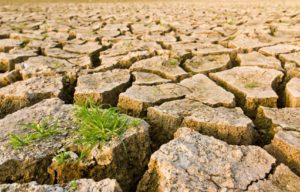
The Mediterranean basin is one of the global water stress hotspots and faces mounting pressure from climate change and growing demand. Surrounded by 21 countries with over 500 million people, this climate change hotspot faces unprecedented water challenges that demand immediate and coordinated actions. Since the pre-industrial period (1850), atmospheric surface temperatures have risen by 1.45°C on average, while renewable water resources are projected to decrease by 15-35% by century’s end (2080-2099). The unbalanced reality is significant: northern Mediterranean countries possess 67-74% of regional water resources, while southern nations like Egypt struggle with as little as 589 m³ per capita annually, well below the water scarcity threshold (1000 m³/an/capita).
A clear relationship exists between the Mediterranean water cycle and Mediterranean forests. Forests play major roles in water transfers to the atmosphere through evapotranspiration processes, facilitate water infiltration via root networks, reduce flooding events, and ensure soil conservation by limiting erosion.
Conversely, the functioning, structure and resilience of Mediterranean forests are highly dependent on water availability and on the dynamics of the large-scale water cycle. Changes in precipitation patterns, rising temperatures, increased evapotranspiration demand and the growing frequency of extreme events associated with climate change directly affect forest health, productivity and regeneration capacity. Droughts, wildfires and land degradation processes are both drivers and consequences of altered forest–water interactions.
Forests and woodlands cover approximately 28% of the Mediterranean region (FAO, 2025). These natural assets are under increasing pressure and growing exposure to climate change impacts, including droughts, wildfires, and land degradation, with 80 million hectares identified as vulnerable. Beyond climate challenges, Mediterranean population growth and associated activities intensify forest loss and degradation (Plan Bleu, 2020 State of the Environment and Development). In this context, the disruption of forest–water feedback loops risks amplifying water scarcity, ecosystem degradation and climate vulnerability at the regional scale.
This consultancy therefore aims to deliver a holistic analysis of forest–water interactions in the Mediterranean, explicitly examining how forests influence the large water cycle and how changes in the water cycle, under climate change, in turn affect forest dynamics. By framing Mediterranean forests as nature-based solutions that both depend on and reinforce hydrological processes, the study seeks to support more integrated decision-making in forest management, water governance and climate adaptation strategies.
Tasks description
Scope of the work
The analysis will cover all 21 Mediterranean countries: Albania, Algeria, Bosnia and Herzegovina, Croatia, Cyprus, Egypt, France, Greece, Israel, Italy, Lebanon, Libya, Malta, Monaco, Montenegro, Morocco, Slovenia, Spain, Syria, Tunisia, and Türkiye.
Rather than relying solely on national-level analyses, candidates are invited to propose and justify the most relevant geographical scale(s) for analysing forest–water interactions in the Mediterranean context, for instance through sub-regional groupings, bioclimatic zones or other coherent spatial frameworks.
A particular focus on Morocco and Tunisia is expected. The study will serve as an “umbrella” analysis feeding into other 2026–2027 Plan Bleu thematic activities on forest management practices for climate change adaptation in both countries.
Within this consultation we encourage multi geographical scale assessments. This will allow in-depth analysis at more local levels for potential territories identified as priority areas of intervention.
Specific objectives
This study aims specifically to :
- Provide a consolidated and up-to-date overview of forest–water interactions in the Mediterranean basin under climate change, highlighting the main hydrological, ecological and climatic processes at play and the key trends affecting their functioning.
- Analyse how climate change is altering forest–water feedbacks across the Mediterranean, including impacts on water availability, forest health, resilience and ecosystem services, with attention to regional and sub-regional specificities.
- Identify priority areas and typologies of territories where forest–water interactions are most at risk, based on exposure to climate pressures (e.g. drought, heat, fire), land-use dynamics and governance constraints, and outline broad adaptation or mitigation pathways.
- Identify key principles, enabling conditions and governance mechanisms that support more integrated approaches linking forest conservation, sustainable forest management and water management, across relevant geographical scales.
Axes of reflexion
The following sub-themes are indicative but not exhaustive. Our goal is to build a comprehensive understanding of what are the main challenges, what are the related impacts, what actions should be prioritized, what limits and barriers such actions are facing, which enablers to leverage, which good practices to transfer, and why, so that policymakers, users, Mediterranean forest conservation actors and water practitioners, civil society, and other stakeholders can design and implement holistic strategies to increase Mediterranean forests and water cycle resilience, being effective, equitable, and sustainable.
- Biophysical dynamics, ecosystem services and co-benefits
Primarily addresses the abiotic and biotic dynamics, as well as physico-chemical relationships between Mediterranean forest and water resources.Existing literature should be synthesized, in order to provide an overview of these natural processes and interactions in the Mediterranean. This would allow us to showcase the mutual co-benefits (direct and indirect influences and feedback loops) between forest ecosystems and water resources. Temporal variability and spatial diversities could be introduced in this first section/axe of research, setting the ground for Mediterranean contrasted socio and environmental systems.
- Pressures – climate change and anthropogenic impacts
This section is the core of the work as it will identify the main pressures and accumulated impacts (both on water cycle and forest systems), the key areas of intervention and their related vulnerability degrees/adaptation capacities. Here again the impacts are largely documented, but they could be exhaustively compiled in the report with a regional perspective providing regional/national/local focus for the most exposed territories. As water can be considered as a pollutant vector, it would be also interesting to tackle the water pollution impacts favored by water infiltration, watershed flushes and river flows and how Mediterranean forests are impacted and can increase such impacts mitigation. This would also reinforce the water-forest relationship as a land to sea continuum.
- Governance and policy framework assessments
This part of the assessment should focus on the analysis of governance and policy frameworks, focussing on forest and water management. This could include a policy review (with cross-analysis comparison between countries) to identify intervention points to address deforestation and/or enhance reforestation in appropriate areas. Taking ecosystems as the foundation of the WEFE approach, WEFE strategies related to forest and water management could be explored.
- Forests as nature based solution and restoration actions
In the context of water scarcity, it should be evaluated if and under which conditions forest could function as a nature-based solution to tackle water scarcity in the Mediterranean. Good practices should be identified to complement this analysis. This could also focus on existing reforestation projects and showcase ecosystem services that benefited the local communities close by in the context of the WEFE nexus. Furthermore, specific areas for reforestation in the Mediterranean could be mapped to support sustainable water management.
- Regional variability and case studies
The Mediterranean basin is a climate change hotspot and it’s often considered as a living lab. Both for Mediterranean forests and water cycle, the regional variability is tangible and therefore presenting highly contrasted situations according to the geographical location. A dedicated part of the study could address this variability both on the geographical and temporal scales. Comparison of case studies are welcomed. This will illustrate clearly the differences between mediterranean areas and their related challenges in terms of forest and water resources conservation.
Working methodologies
Applicants may propose alternative or innovative approaches to their methodology and to the consultation process (e.g. survey/questionnaire, tables, other tools) to collect expert inputs, should they consider this to add value. A list of initial organizations to engage with would be appreciated which will be refined with Plan Bleu’s contacts.
Timeline and deliverables
Expected deliverable :
- Inception report
Proposed analytical framework and relevant geographical scale(s) of analysis for the Mediterranean context.
- Mediterranean forest–water assessment report (Cf. specific objectives)
A technical report (between 50-60 pages without appendices) that will integrate:
- Holistic analysis of forest–water interactions under climate change at Mediterranean and sub-regional scales and evaluation of potential climate adaptation solutions.
- Identification of most critical areas and key recommendation actions align with local/national governances.
- Focused analysis and key insights for Morocco and Tunisia and other potential case studies.
- Policy recommendations
Policy-oriented executive summary highlighting key messages and recommendations for targeted critical areas. These recommendations will be actionable and based on analytical assessment provided in the previous report. They will allow Mediterranean decision makers to switch from technicality to practicality and to implement concrete measures that will guarantee Mediterranean forest conservation with sustainable use of natural water resources.
- Synthetic powerpoint presentation
Synthetic PPT. presentation that will highlight the study’s key results, to be presented in upcoming Plan Bleu events.
The timeline with the expected deliverables is detailed hereunder with a start of the working activities plan for early April.
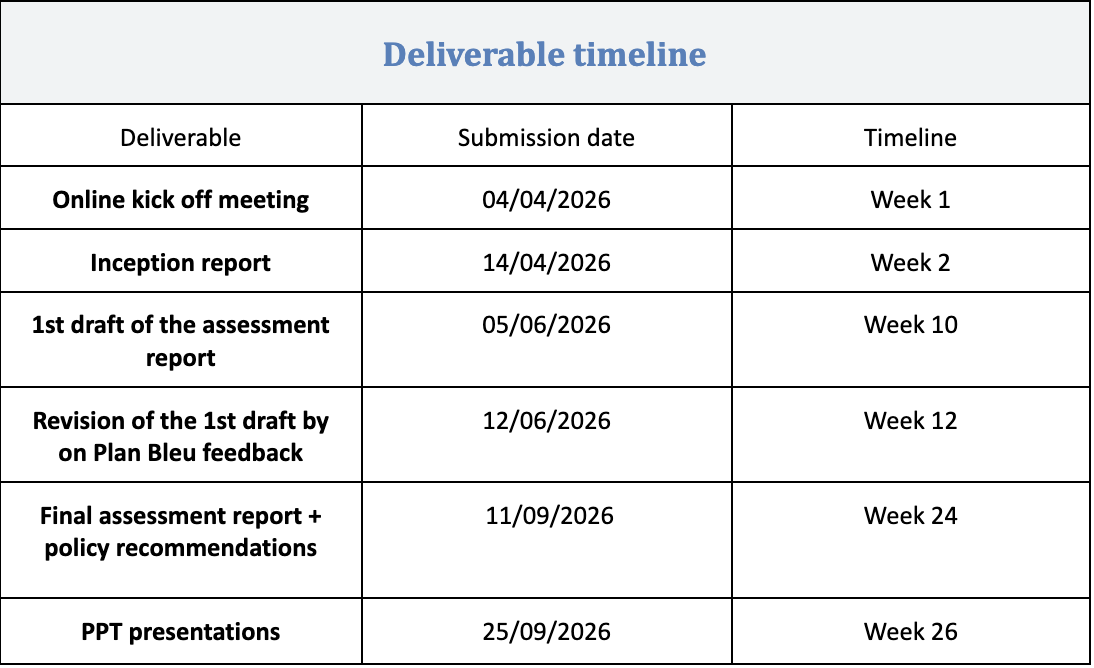
All deliverables mentioned in the table above have to be sent to Plan Bleu in English. The deliverables have to be formally approved by Plan Bleu. No payments will be made without prior approval of the linked deliverables.
Work assessment
The Consultant will be supervised by Ms. Alice Wittevrongel (Biodiversity Project Manger), Mr. Samson Bellières (Water Project Manager and GIS expert) and Ms. Insa Behrens (Climate Change Adaptation Project Manager).
Budget
The available budget for this consultancy is 13 146 euros VAT included shared between a team of experts (multidisciplinary Mediterranean experts with a geographical balance between Mediterranean shores). Proposals should not exceed this amount.
Selection of the consultants
Plan Bleu is seeking an experienced team of Mediterranean experts (with a good geographical balance between shores) with technical and scientific expertise on water and forest related topics with significant background in data analysis. The experts are expected to have a strong knowledge of (1) the state of Mediterranean water resources, its challenges, related initiatives, and institutional frameworks that surround these topics, and (2) Mediterranean forests, its vulnerability to climatic and anthropogenic pressures, water scarcity and related conservation challenges.
In face of such transversal and holistic work plans, Plan Bleu will hire a team of experts ideally from the northern, southern and eastern shores. Moreover, Plan Bleu encourages all experts such as Mediterranean researchers, individual consultants, association of consultants and consulting firms to apply for this assignment. Selected candidates will demonstrate the following competences and criteria:
- Education background: University diploma of at least Master’s level or equivalent in water resources management, forestry, environmental sciences, hydrology, climate science, geography, ecology, and/or data analysis and/or socio-economic sciences. PhD level will be appreciated.
- Professional Experience: Minimum of 5 years of relevant experience in the field of sustainable development, with strong knowledge of Mediterranean water related issues and policy aspects.
- Expertise in forest–water interactions, hydrological processes, or ecosystem functioning, particularly in the Mediterranean
- Proven experience working at the science–policy interface, with the ability to translate technical knowledge into policy-relevant messages and recommendations.
- Knowledge of forest and water governance frameworks in the Mediterranean region, including institutional coordination challenges and cross-sectoral approaches.
- Minimum of 5 years of working experience in and specific knowledge of environmental issues in the Mediterranean as well as of the Barcelona Convention UNEP/MAP system, and other governance processes in the region.
- A proven experience in working in multistakeholder cooperation projects environment and development issues.
- Thematic and analytic experience: Solid experience in water related projects. Proven experience in the field of sustainable development goals is an asset. Strong experiences in mediterranean forests faced climatic and anthropogenic pressures and related conservation challenges. Assessment of anthropogenic pressures on forest resources. Understanding of coupled human-natural systems in forest and water resources management.
Contractual and financial terms
All deliverables must be formally approved by Plan Bleu before proceeding to the next phase. Payment is conditional upon approval of corresponding deliverables. In case of non-compliance, the consultant has 5 working days to submit a revised version at no additional cost.
The acceptance of the selected offer implies acceptance of the terms and detailed schedules outlined in these Terms of Reference, including the following payment schedule (negotiable) :
- 15% amount of the contract as a down payment will be paid upon the contract signature
- 40% will be paid as an intermediate payment upon delivery of the first analytical draft following the consultation process
- The balance payment will be paid upon validation of the final draft submission and the final presentation.
A properly issued invoice will be required for the scheduled payments, containing the following mandatory details:
- Full name + address of the service provider
- SIRET number (France) or tax number (for non-France)
- Invoice issuance date
- Invoice number
- Service description (e.g., name of the deliverable)
For foreign consultants: a sworn statement indicating that they are up to date with their tax and social security contributions in their country (and ideally, where possible depending on the country, a document from the organisations to which they contribute proving that they are up to date).
For experts/consultants based in France:
A document certifying their registration with the Registre du Commerce et des Sociétés (Commercial and Companies Register), or their professional ID card proving registration with the Répertoire des Métiers (Trades Register), or their certificate of registration with URSSAF.
In addition, a certificate of compliance (“attestation de vigilance”) from the Social Security for the Self-Employed (Sécurité sociale des indépendants), if they are not affiliated with the general Social Security scheme.
For experts based outside France, they will be required to provide a sworn statement certifying that they are up to date with their tax and social security obligations in their country of residence.
Use of Artificial Intelligence
Clause 1 – Controlled use of artificial intelligence
The service provider is authorized to use generative artificial intelligence (AI) tools, provided that
their use is strictly limited to support functions: assistance with structuring, brainstorming, document exploration, or editorial optimization. The use of AI may under no circumstances replace the analytical work, source verification, or expert writing expected within the scope of the assignment. Artificial intelligence must under no circumstances replace human expertise or rigorous scientific methods. In particular, it may not be used to produce numerical estimates or to generate modeling results (economic, econometric, mathematical, or other), which must be based on validated, documented approaches implemented by the service provider. Any reference to a study, article, numerical data, or academic source must be rigorously traceable and verifiable through precise references (title, author, publication, date, or link).
Clause 2 – Responsibility for content and transparency
The service provider remains fully responsible for the quality, accuracy, reliability, and consistency of the deliverable, including in the case of partial use of artificial intelligence tools. All information, data, or quotations appearing in the final deliverable must have been verified by the Consultant, regardless of the method of production. In the event of a clear breach (fictitious sources, fabricated quotations, inconsistent data), Plan Bleu reserves the right to request a revision at no additional cost, or even to terminate the contract and cancel all or part of the payment in the event of failure to meet deadlines. The Consultant is obligated to explicitly declare any use of AI tools in the preparation of deliverables. The Consultant must transparently indicate the parts of the work that were carried out with the assistance of an AI tool and may be asked to
provide the methodology or queries (prompts) used.
Clause 3 – Quality responsibility
The Consultant remains solely responsible for the accuracy, originality, verification, and professional quality of deliverables, including those produced or assisted by AI. The use of AI tools cannot, under any circumstances, justify factual errors, plagiarism, bias, or breaches of confidentiality.
Clause 4 – Non-compliance and consequences
In the event of non-compliance with this clause, the client may request the Consultant to:
- revise the deliverables at no additional costs or, in the event of serious or repeated breach, to apply the contractual provisions relating to non-conformity or termination.
How to apply
Interested candidates are invited to submit the following documents :
- A technical offer including a summary of a scientific article, comprising a brief description of the methodology and a curriculum vitae highlighting relevant experience in water and economics-related fields.
- A financial offer with an estimation of working days.
The application files must be submitted no later than 6 April 2026 to [email protected], [email protected], [email protected]. The selection and kick off meeting will take place during the week of 23 March 2026.